
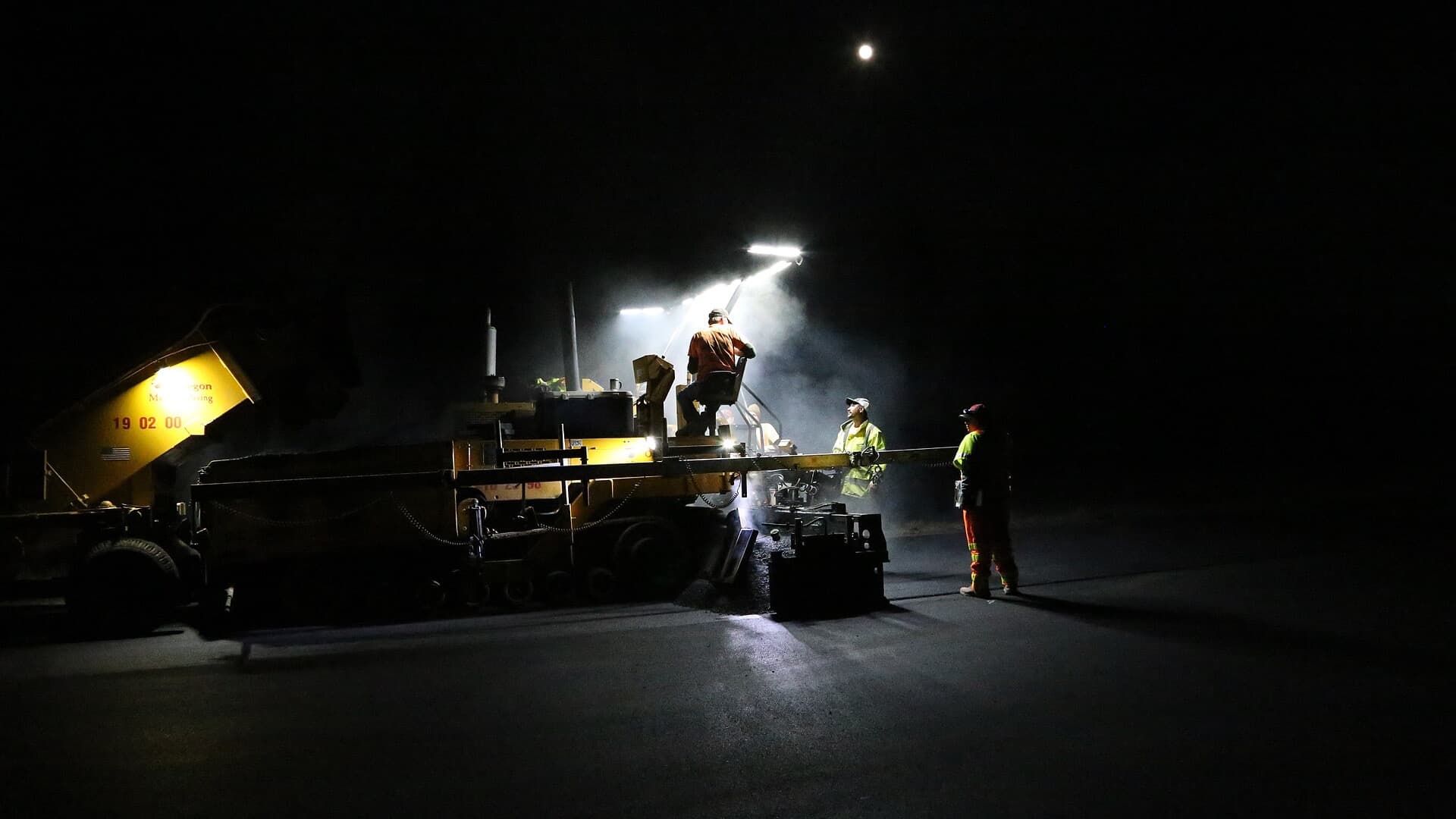
Temporary lighting is a common jobsite power load. Exterior work areas may use mobile LED light towers, while buildings under construction often use string lights, high-bay fixtures, wide-area lights, and portable task lights. Access routes, storage areas, office trailers, and emergency egress can add separate lighting circuits.
LED fixtures use less electricity than older metal-halide or incandescent equipment, but the total energy requirement can still be substantial when several circuits operate for a 10- or 12-hour shift. Security, access, and containment lighting may continue after the work crew leaves.
This guide explains how to convert a construction lighting plan into battery capacity in kWh and inverter power in kW. It covers externally powered LED towers and temporary lighting circuits. Light towers with their own integrated batteries are also discussed, but their internal storage is not added to the site battery calculation unless they are being recharged from it.
Begin with the lighting requirement, not the battery
The electrical calculation should follow the lighting plan. Fixture wattage alone does not show whether a work area has adequate illumination.
In the United States, OSHA's construction illumination standard lists minimum values for different areas and operations. Table D-3 includes 5 foot-candles for general construction area lighting, 3 foot-candles for several general construction activities and access areas, 10 foot-candles for construction plants and shops, and 30 foot-candles for first-aid stations and offices.
OSHA also notes that actual illumination at a work surface is best checked with a light meter because fixture type, distance, air conditions, surface colour, and reflectivity affect the result. Canadian requirements vary by province and type of work.
A practical lighting plan should account for:
- Required illumination at the work surface
- Area dimensions and mounting height
- Fixture beam pattern and aiming angle
- Shadows from equipment, formwork, walls, and materials
- Glare for workers, equipment operators, drivers, and nearby properties
- Dust, fog, precipitation, and reflective surfaces
- Access routes, stairs, ladders, exits, and emergency equipment
- Changes to the work area during the shift
- Lighting needed after work stops
- Environmental and hazardous-location ratings
Use a photometric plan, manufacturer spacing data, and field light-meter readings where the work or site conditions require them. Adding a larger battery does not correct poor fixture placement.
Record the power draw of every fixture
Prepare a load schedule from equipment nameplates, product data sheets, or measured input power. For each lighting group, record:
- Number of fixtures
- Watts per fixture or complete unit
- Input voltage and phase
- Operating current
- Power factor where published
- Dimming level
- Operating hours
- Control, charger, or mast power
- Plug and receptacle type
- Circuit and overcurrent-protection requirements
LED fixture wattage is usually the most useful starting point. Include drivers and controls where their consumption is not already included in the published input rating.
Do not use lumen output as electrical input. Lumens describe light output, watts describe power consumption, and foot-candles or lux describe illumination on a surface. A fixture with a high lumen rating can still produce an unsuitable result if it is aimed or spaced incorrectly.
Typical LED jobsite lighting loads
Published commercial equipment shows how wide the range can be:
| Equipment example | Published lighting configuration | Published electrical data |
|---|---|---|
| Lind Beacon LED Tower | Four wide-area LED heads | Four 200 W heads, 800 W per tower |
| Generac MLTB battery light tower | Four LED heads | Current specification sheet lists four 190 W fixtures and a 17 kWh battery |
| Trime X-Eco Battery tower | Four LED floodlights | Four 100 W fixtures, 400 W total lighting load |
| Lind LED bulb string light | Ten bulbs on a 100 ft string | 17 W per bulb, 170 W per string |
| Lind Beacon360 Blaze | One wide-area fixture | 100 W |
| Lind Beacon360 Trek | One portable area fixture | 60 W |
These figures are examples, not defaults for every tower or string-light system. Product configurations change, and two fixtures with similar light output may have different input power and beam patterns. Use the data for the exact equipment being connected.
Calculate daily lighting energy
For each lighting group:
Input power in kW x operating hours = energy in kWh
Add the groups together, then include an allowance for inverter losses, operating reserve, schedule variation, cold temperature, cable losses, and unplanned lighting.
Worked example: exterior and interior jobsite lighting
Assume a project needs:
- Two plug-in LED light towers, each with four 200 W heads, for 12 hours
- Three 100 ft LED string-light runs, each with ten 17 W bulbs, for 12 hours
- Four 100 W wide-area task lights for 10 hours
- Controls and small supporting loads averaging 50 W for 12 hours
| Lighting load | Quantity and rating | Hours | Energy |
|---|---|---|---|
| Plug-in LED light towers | 2 x 0.80 kW | 12 | 19.2 kWh |
| LED string lights | 3 x 0.17 kW | 12 | 6.1 kWh |
| Wide-area task lights | 4 x 0.10 kW | 10 | 4.0 kWh |
| Controls and support loads | 0.05 kW | 12 | 0.6 kWh |
| Total | 2.56 kW when all loads operate | 29.9 kWh |
Adding a 20% planning allowance gives:
29.9 kWh x 1.20 = 35.9 kWh
The 20% allowance is only an example. A project may need more reserve if shift length varies, low temperature reduces usable energy, lighting is required for safe shutdown, or the battery cannot be recharged promptly.
Separate running power from stored energy
The worked example has two different requirements:
- Running power: 2.56 kW when every lighting group is on
- Stored energy: 35.9 kWh after the example planning allowance
An inverter rated for 3 kW may appear to cover the running load, but it would leave little capacity for additional circuits, charging equipment, or nameplate uncertainty. Battery capacity must also be large enough for the complete operating period.
LED lighting normally has less severe starting demand than motor loads, but drivers can draw inrush current when many fixtures are energized together. Confirm the manufacturer's circuit-loading limits and avoid switching a large group on at once unless the distribution system and inverter are designed for it.
Check temporary distribution and voltage drop
Lighting is often distributed over long distances. Cable length, conductor size, connectors, splitters, and repeated daisy chains can create voltage drop and additional loss.
The temporary electrical plan should verify:
- Conductor ampacity and voltage-drop limits
- Grounding and bonding
- Ground-fault protection
- Wet-location and outdoor ratings
- Connector and receptacle compatibility
- Protection from vehicles, tools, water, sharp edges, and foot traffic
- Circuit loading for daisy-chained fixtures
- Disconnect and emergency-shutdown access
- Inspection requirements and local permits
Increasing source voltage or using multiple distribution points may reduce long-run voltage drop, but the complete installation must use compatible, approved equipment. A qualified electrical contractor should design and inspect the temporary distribution system.
Use controls to reduce unnecessary energy use
Lighting controls can reduce kWh without reducing required illumination during active work. Suitable controls may include:
- Timers matched to the work schedule
- Photocells for dusk-to-dawn operation
- Zoned switching
- Dimming where the fixture and lighting plan permit it
- Occupancy controls in intermittently used interior areas
- Separate security and active-work settings
- Remote status and low-battery alarms
For example, reducing four 200 W light heads to 50% input for six non-working hours can save approximately 2.4 kWh if the fixture's electrical consumption falls proportionally. The actual relationship between dimming percentage, input watts, and light output should be confirmed from manufacturer data or measurement.
Critical access, exit, and emergency lighting should not be removed simply to reduce energy use. Control sequences also need a reliable recovery state after a power interruption.
Integrated battery light towers and external battery power
Commercial battery light towers combine fixtures, storage, controls, mast, and charging equipment in one package. Generac publishes a 17 kWh battery and 21.5 hours of light-only runtime at 100% illumination for one current MLTB specification. Trime publishes four 100 W floodlights with 36- to 72-hour configurations for its X-Eco Battery tower.
These runtime figures apply to the manufacturer's complete system and test conditions. They should not be transferred directly to another battery or tower. Temperature, dimming, battery age, control loads, and operating settings can change actual runtime.
An external mobile battery can instead supply compatible plug-in towers, string lights, and other temporary circuits. This approach can consolidate several loads and provide a larger energy reserve, but it requires a separate distribution plan and verified equipment compatibility.
Hybrid light towers are another option. Wanco, for example, offers a tower that runs four 200 W LED fixtures from a lithium battery and starts an onboard diesel generator when recharge is required. Hybrid operation can reduce engine hours, but it still requires fuel, exhaust management, and maintenance.
Plan the recharge window
The daily lighting load must be restored before the next shift. Compare battery energy used with the power and time available for charging.
If the worked example uses 29.9 kWh and the charger receives 5 kW from a temporary service, the ideal charging time is:
29.9 kWh / 5 kW = 6.0 hours before charging losses
Actual charging takes longer because of conversion losses, charge tapering, temperature limits, and any lighting that remains on while the battery charges.
Possible recharge sources include:
Grid or temporary utility service
A limited service can recharge the battery during daylight or between shifts. The lighting load, battery charger, and other site loads must remain within the service limit.
Generator charging
A generator can recharge the battery during a scheduled period instead of running all night at a low lighting load. Fuel, noise, exhaust placement, charging power, and backup procedures remain part of the plan. Our guide to electric and diesel generators for commercial sites covers these operating differences.
Solar charging
Solar can offset daytime energy where panel area, exposure, and season allow. Night lighting creates a predictable load after solar production ends, so sufficient storage and a dependable backup recharge source are still required. See our guide to solar charging in cloudy weather for the main planning variables.
Include other jobsite power loads
A battery used for lighting may also supply office trailers, tool chargers, cameras, communications equipment, ventilation, or pumps. Add these loads to one interval schedule instead of sizing each system independently.
Heaters and large motor loads can change the inverter requirement quickly. Reserve energy for lighting where loss of illumination would prevent safe movement or shutdown.
Related calculations are available in our guides to portable power for jobsite tools, construction site office trailer power, and battery power for construction ventilation.
Cold-weather and environmental planning
Night lighting systems commonly operate in the coldest part of the daily cycle. Low temperature can reduce available battery energy and charging rate. Snow, ice, and frozen ground can also affect tower setup, cable routing, and solar recharge.
Confirm:
- Battery operating and charging temperature limits
- Enclosure heating and its energy use
- Fixture, cable, and connector temperature ratings
- Wind rating and stabilizer setup for towers
- Drainage and wet-location protection
- Snow and ice removal around equipment
- Reduced winter solar production
- Additional reserve for longer winter nights
Our cold-weather battery power guide provides a fuller checklist for winter construction.
Where Skyridge Power systems fit
The Apex Station is the closer match for the complete worked example. Its published specifications include 120 kWh of LiFePO4 storage, 30 kW continuous output, configurable 120/240 V output, single-phase and three-phase configurations, and grid, generator, or solar charging compatibility.
The example's 35.9 kWh planning requirement and 2.56 kW combined lighting load are below those published ratings. Final selection still depends on actual fixture input, usable reserve, distribution voltage and phase, inrush, cable loss, temperature, recharge timing, other site loads, and required backup duration.
The Apex Mobile provides 16 kWh nominal capacity, 14.4 kWh usable capacity, and 12 kW continuous output. One 800 W plug-in LED tower operating for 12 hours uses 9.6 kWh before losses and reserve. Adding the example 20% allowance gives 11.5 kWh, which is below the published usable capacity. Actual runtime still needs confirmation from the tower's measured input, battery operating limits, temperature, and cable losses.
Apex Mobile is not sized for the complete 35.9 kWh worked example without recharging or reducing the connected lighting. Apex Station provides more capacity for several towers, interior circuits, and supporting loads.
Skyridge Power can review lighting schedules, fixture specifications, photometric plans, shift duration, cable runs, other jobsite loads, and recharge options to prepare a project-specific mobile power configuration.
Planning checklist
- Determine required illumination and fixture placement before sizing the battery.
- Verify the lighting plan with manufacturer data and field light-meter readings where required.
- Record watts, voltage, phase, quantity, and operating hours for every lighting group.
- Include controls, mast power, chargers, and supporting loads.
- Calculate kWh for active work, cleanup, access, security, and emergency periods.
- Add inverter losses, reserve, cold-temperature effects, cable losses, and schedule variation.
- Check LED-driver inrush and circuit-loading limits.
- Verify cable ampacity, voltage drop, grounding, protection, and environmental ratings.
- Use timers, zones, and dimming only where required illumination is maintained.
- Define the daily recharge source, charging power, and available charging window.
- Keep enough stored energy for safe shutdown if recharge is delayed.
- Add office, tool, ventilation, communications, and other loads to the same schedule.
- Test the complete system under expected nighttime and weather conditions.
Primary references include OSHA's construction illumination standard and its interpretation on measuring illumination at construction sites. Equipment examples are based on published information for the Generac MLTB battery light tower, Trime X-Eco Battery tower, Wanco hybrid battery light tower, Lind wide-area LED lights, and Lind LED string lights.
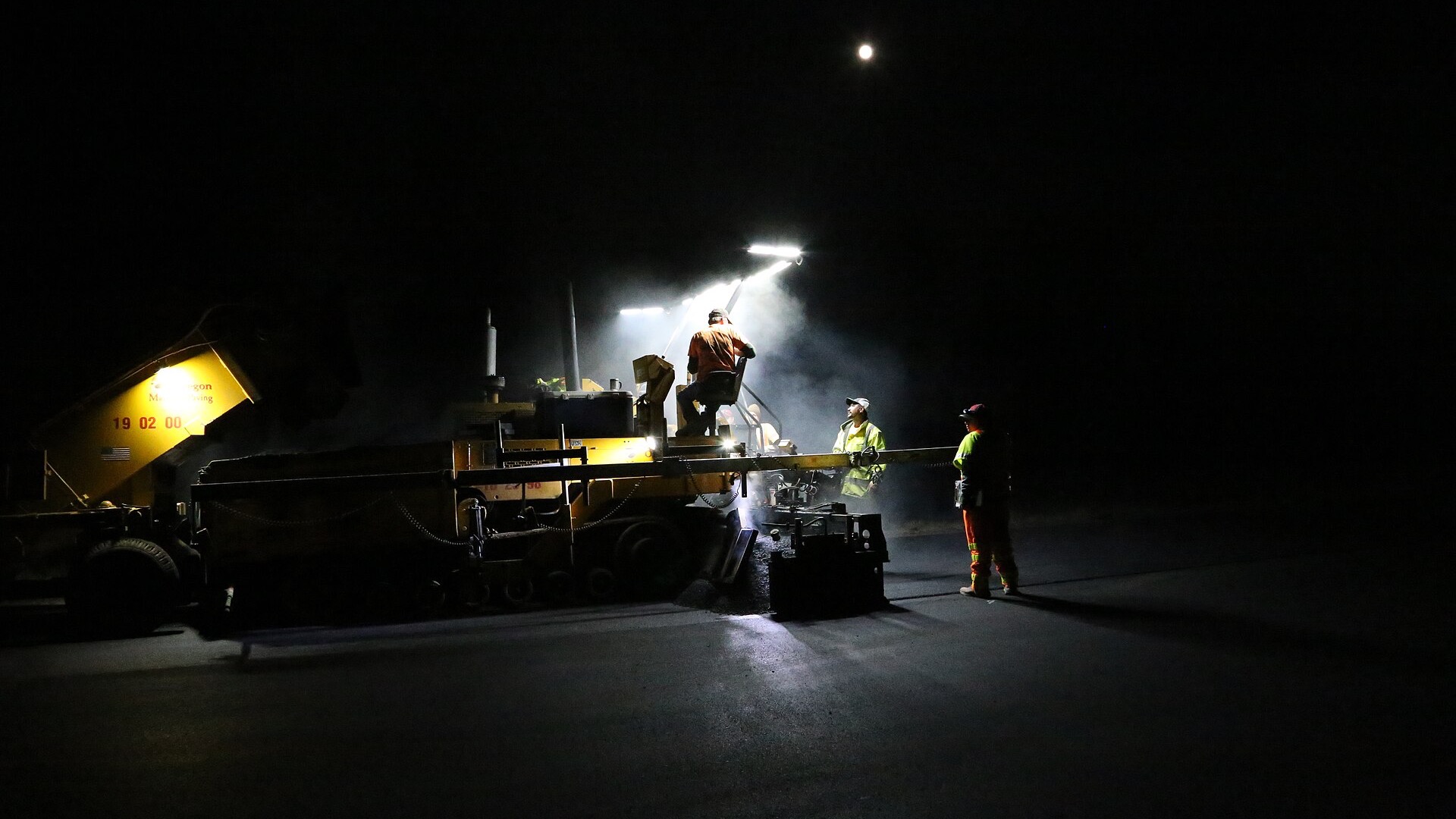
Image source: Night work (30277711982).jpg by the Oregon Department of Transportation, licensed under CC BY 2.0. The image was cropped to a 1920 x 1080 landscape format.
