
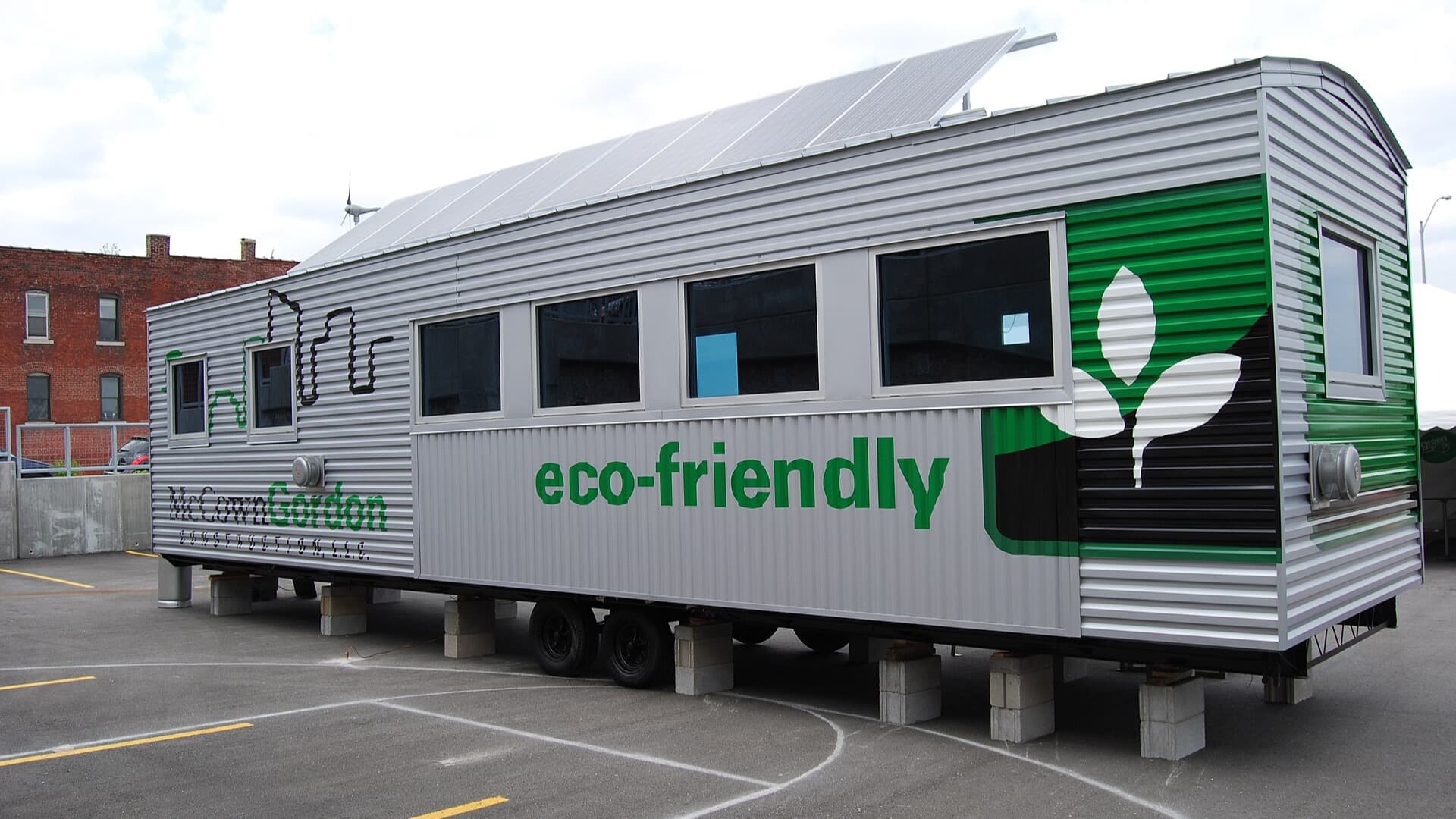
Construction site office trailers can look like modest electrical loads. Computers, monitors, lighting, networking equipment, and a small refrigerator use relatively little power on their own. Heating and cooling can change the load substantially, while a microwave, coffee maker, printer, or water heater can create short periods of higher demand.
A useful power plan therefore needs two separate calculations. Energy in kilowatt-hours (kWh) determines how long a battery can support the trailer. Power in kilowatts (kW) determines whether the inverter and temporary distribution can operate all connected equipment at the same time.
This guide explains how to collect the load data, prepare a daily energy estimate, account for seasonal HVAC demand, and decide whether battery-only or hybrid operation is more practical.
Start with the trailer electrical service
Record the electrical configuration before estimating the battery. A site may have one small office trailer, a multi-section complex, or several trailers supplied from a common temporary distribution panel.
Document:
- Service voltage and phase
- Main-panel rating and breaker schedule
- HVAC type, quantity, nameplate current, and starting data
- Electric resistance heaters or baseboard heaters
- Water heater, microwave, coffee maker, refrigerator, and other kitchen loads
- Computers, monitors, printers, networking, security, and access-control equipment
- Interior and exterior lighting
- Occupied hours and overnight loads
- Trailer quantity and the circuits shared between trailers
- Cable distance from the power source
- Available grid, generator, and solar charging sources
A panel rating is not an energy measurement. A 100 A panel describes an upper limit for the electrical service, not the power that the trailer normally uses. Battery sizing should use measured or defensible load data.
Measure representative operation
The best input is a temporary power logger or submeter installed by a qualified electrician. A one-week measurement period can capture occupied days, nights, HVAC cycling, and short-duration kitchen loads. Longer logging may be useful where weekends or weather conditions create a different pattern.
Record at least:
- Highest 15-minute or shorter average kW
- Instantaneous peak where the meter supports it
- Total kWh per day
- Overnight base load
- Daily outdoor temperature and weather conditions
- HVAC operating hours
- Any generator charging periods or interruptions
The U.S. Department of Energy notes that building energy use changes with climate, weather, operating activity, and construction. A trailer measured during mild weather should not be assumed to represent its winter heating or summer cooling requirement.
If measurement is not yet possible, prepare a load schedule from equipment nameplates and realistic duty cycles. Replace the estimates with measured data before final procurement.
Calculate daily energy in kWh
For each load:
Average power in kW x operating time in hours = energy in kWh
For cycling equipment, use its average input over the period rather than multiplying full nameplate power by the entire day. A 3 kW air conditioner that runs for 20 minutes of each hour has an average load of approximately 1 kW over that hour. Duty cycle changes with temperature, solar gain, insulation, doors, occupancy, and thermostat settings.
Worked example: one office trailer
The following is an illustrative planning example for one occupied trailer. It is not a standard load profile.
| Load | Planning power | Runtime | Daily energy |
|---|---|---|---|
| HVAC, averaged over occupied hours | 2.00 kW | 10 hours | 20.00 kWh |
| Computers and monitors | 0.60 kW | 10 hours | 6.00 kWh |
| Interior and exterior LED lighting | 0.25 kW | 12 hours | 3.00 kWh |
| Network and security equipment | 0.12 kW | 24 hours | 2.88 kWh |
| Refrigerator, average input | 0.10 kW | 24 hours | 2.40 kWh |
| Printer, microwave, and coffee maker, diversified | 0.50 kW | 2 hours | 1.00 kWh |
| Calculated daily total | 35.28 kWh |
Adding a 20% planning allowance for conversion losses, load variation, and reserve gives:
35.28 kWh x 1.20 = 42.34 kWh
The allowance is not a universal standard. Battery reserve settings, temperature, data quality, operating consequences, and recharge reliability should determine the final margin.
Check peak demand separately
The worked example uses 35.28 kWh during the day, but the battery inverter must also support the highest simultaneous load. A simple coincident peak might include:
| Concurrent load | Example power |
|---|---|
| HVAC while running | 3.0 kW |
| Computers, monitors, and network | 0.8 kW |
| Lighting and refrigerator | 0.4 kW |
| Microwave or coffee maker | 1.3 kW |
| Simple running peak | 5.5 kW |
Motor and compressor startup can exceed normal running demand for a short time. The HVAC nameplate, manufacturer data, starting method, inverter surge rating, overload duration, voltage response, and other connected loads all need review. An inverter with adequate continuous output can still be unsuitable if it cannot start the compressor.
Soft-start equipment may reduce HVAC starting demand where it is approved by the HVAC manufacturer and compatible with the compressor. It does not reduce the unit's normal running energy.
Heating can dominate the energy estimate
Electric resistance heat is a large and direct load. A 4.8 kW heater operating for eight hours uses:
4.8 kW x 8 hours = 38.4 kWh
That one heater would use more energy than all non-HVAC loads in the worked example. Multiple portable 1.5 kW heaters can have a similar effect and may also overload branch circuits if they are added without an electrical review.
Heat pumps generally deliver more heat per unit of electricity than resistance heaters, but their output and efficiency vary with outdoor temperature and equipment design. Cold-weather capacity, defrost operation, auxiliary heat, and startup demand should be checked using the manufacturer's data for the expected site conditions.
For a deeper seasonal review, see our guide to cold-weather battery power for construction sites.
Include the overnight base load
Construction offices may remain partly active after the crew leaves. Networking, cameras, access control, alarms, servers, refrigerators, freeze protection, and exterior lighting can operate overnight.
In the example, networking, security, and refrigeration total about 0.22 kW on average. If those loads operate through a 14-hour unoccupied period, they use:
0.22 kW x 14 hours = 3.08 kWh
Exterior lighting, heating, and a local server could raise that number. Separating overnight loads from occupied loads helps determine whether the battery must cover a full 24-hour cycle or can be recharged when the site closes.
Size a group of trailers from coincident demand
Multiplying one trailer's peak by the number of trailers can overstate normal demand because kitchen and office loads do not all operate at once. Applying too much diversity can understate demand during extreme weather because several thermostats may call for heating or cooling at the same time.
For a trailer complex:
- Measure each trailer or the common feeder.
- Identify the maximum coincident demand for the complete group.
- Separate HVAC from non-HVAC loads.
- Review the coldest and hottest expected operating conditions.
- Add planned trailers and known future equipment.
- Confirm feeder, panel, connector, and cable ratings.
One commercial example shows the scale of this variability. POWR2 describes a 250 kW battery system supporting 17 United Rentals office trailers with HVAC, lighting, and computers. The reported summer load averaged about 30 kW, while the expected winter peak could reach the full 250 kW. That project is not a sizing rule, but it illustrates why trailer count alone does not establish battery requirements.
Battery-only or hybrid operation
Battery-only
Battery-only operation can fit a measured daily load with a defined recharge period. It provides quiet operation and no direct exhaust while discharging. The plan still needs enough reserve for weather changes, extended work, missed charging, and battery operating limits.
Grid-assisted
Where temporary grid service is available, a battery can charge during off-hours and support the trailer during an outage, a service-capacity constraint, or a planned period away from the connection. Charger power must be included when sizing the service.
Battery and generator hybrid
A hybrid configuration can support long projects or large winter loads. The battery can carry low and variable loads, while the generator operates for scheduled charging or sustained high demand. This can reduce continuous low-load generator operation.
The generator must support the connected site load plus battery charging demand when both occur together. Automatic controls should have clear start, stop, low-state-of-charge, fault, and reserve settings. Our comparison of battery electric and diesel generators for commercial sites covers the operating differences.
Solar-assisted
Solar on a trailer or a nearby temporary array can offset part of the daily energy use. Production depends on array size, season, cloud, snow, smoke, shading, orientation, and charge-controller limits. Solar should be modelled by month and location rather than treated as a fixed daily amount.
Temporary distribution and site safety
Battery storage does not remove the need for a compliant temporary electrical installation. OSHA construction requirements cover temporary wiring, overcurrent protection, grounding-type receptacles, equipment grounding conductors, disconnects, and protection from physical damage. Ground-fault protection requirements also apply to relevant construction-site receptacles in the United States.
Canadian requirements vary by province and local authority. The electrical contractor and authority having jurisdiction should confirm permits, inspection, grounding and bonding, ground-fault protection, cable type, weather protection, disconnects, and distribution equipment.
Plan cable routes away from vehicle traffic, standing water, sharp edges, and active work areas. Long cable runs require a voltage-drop check, particularly for HVAC starting. The battery, generator, transfer equipment, and distribution panels should remain accessible for inspection and emergency shutdown.
Where Skyridge Power systems fit
The Apex Station is the closer match for the worked example. Its published specifications include:
- 120 kWh of LiFePO4 storage
- 30 kW continuous output
- Configurable 120/240 V output
- Single-phase and three-phase configurations
- Grid, generator, and solar charging compatibility
- Up to 30 kW of solar input
- Less than 20 ms transfer time
The example's 42.34 kWh planning requirement is below the Apex Station's nominal storage capacity, and its 5.5 kW simple running peak is below the published 30 kW continuous output. This comparison does not confirm a final configuration. HVAC startup, heating demand, usable reserve, temperature, actual duty cycles, cable distance, distribution design, and recharge requirements must be verified.
The Apex Mobile provides 16 kWh nominal capacity, 14.4 kWh usable capacity, and 12 kW continuous output. It may fit a narrow overnight package, an isolated office circuit, or a small trailer with a measured load and regular recharge. Its energy capacity would not cover the complete 42.34 kWh worked example without load reduction or charging during the day.
Skyridge Power can review trailer panel schedules, logged interval data, HVAC specifications, operating hours, site voltage, cable distance, weather assumptions, and recharge sources to prepare a battery-only or hybrid configuration.
Sizing checklist
Before selecting a temporary battery system:
- Record voltage, phase, panel rating, breaker schedule, and cable distance.
- Measure daily kWh, peak kW, overnight load, and HVAC duty cycle.
- Collect HVAC running and starting data.
- Model both mild-weather and design-weather operation.
- Include heating, kitchen, refrigeration, lighting, IT, security, and exterior loads.
- Add conversion losses and an operating reserve suited to the project.
- Use measured coincident demand for groups of trailers.
- Define the grid, generator, solar, or rotation-based recharge plan.
- Confirm temporary wiring, grounding, ground-fault, disconnect, and inspection requirements.
- Test the completed system under representative load before relying on it.
References include the U.S. Department of Energy's guidance on building energy use and operating conditions, OSHA requirements for temporary wiring on construction sites, OSHA guidance on ground-fault circuit interrupters, and the POWR2 case study on battery support for 17 construction office trailers.
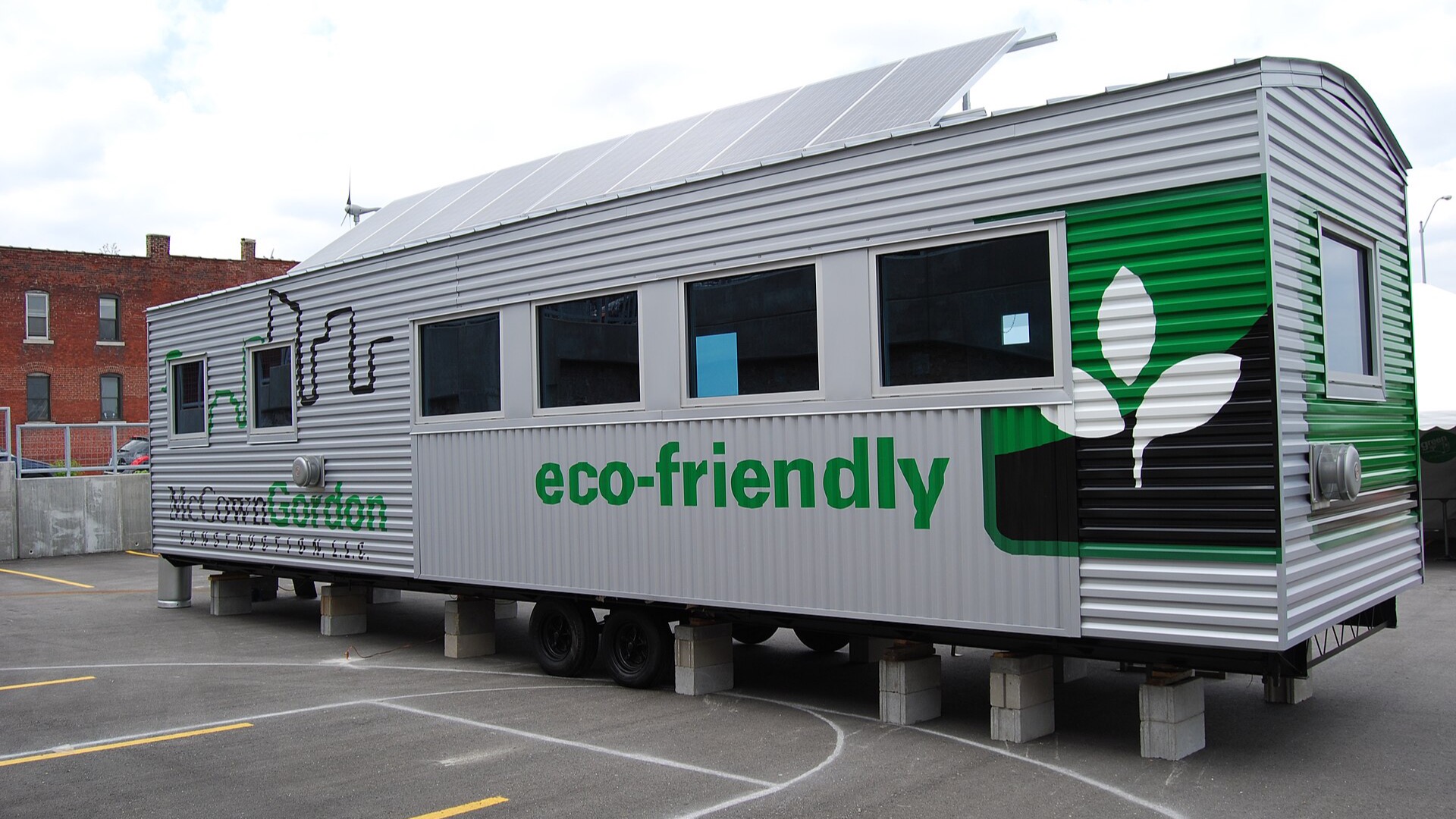
Image source: McCownGordonGreenTrailer.jpg by Barchawk, licensed under CC BY-SA 3.0. The image was cropped and resized to a 16:9 landscape format.
