
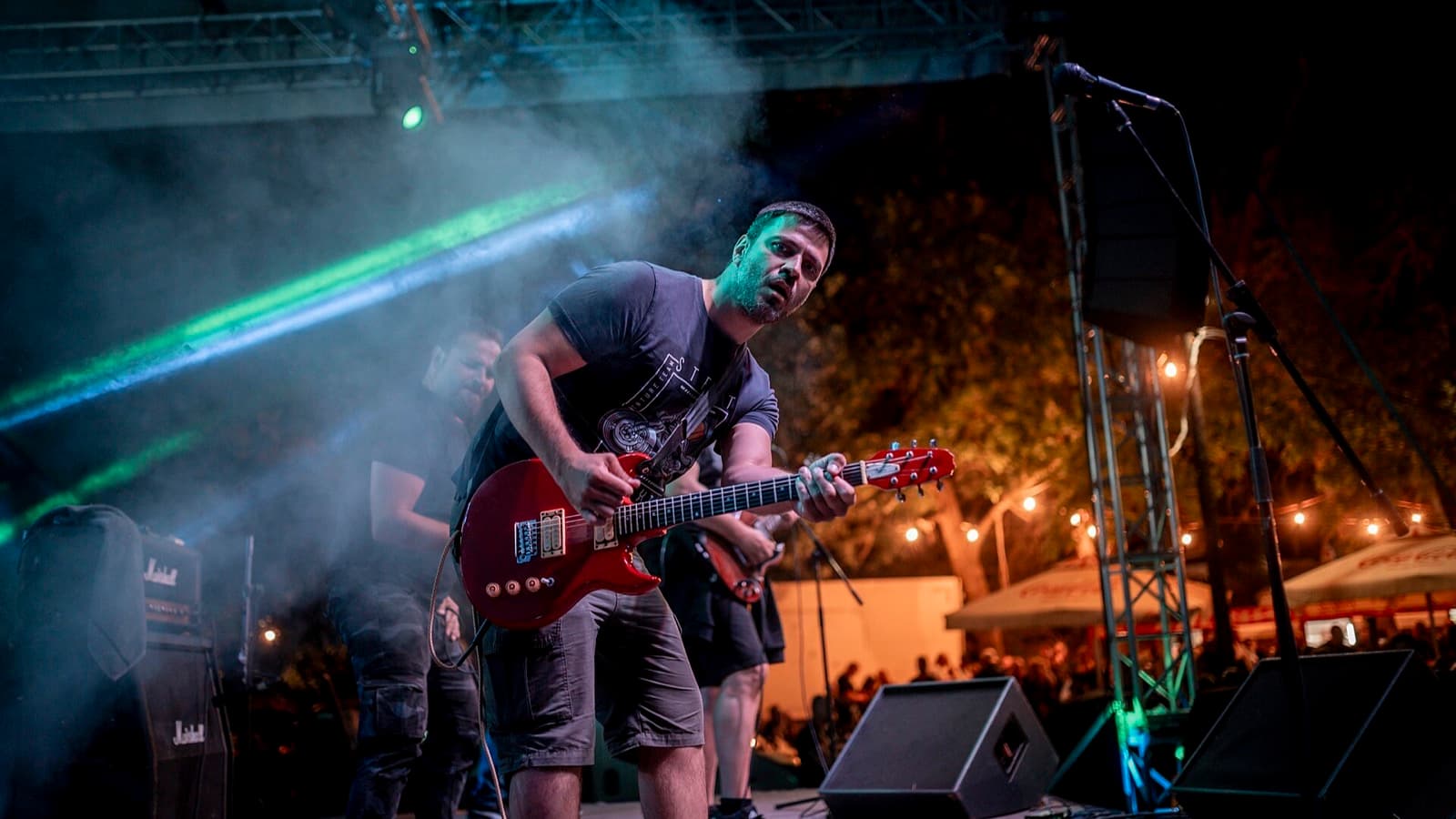
Outdoor events often combine several temporary electrical systems on one site. A stage may have audio, lighting, video, and control equipment. Vendors may bring refrigeration, cooking appliances, and point-of-sale terminals. Site teams also need lighting, communications, ticketing, medical support, security equipment, and production-office power.
Battery storage can serve many of these loads without direct exhaust or engine noise while discharging. The planning process is different from choosing a generator by its nameplate rating. An event team needs to calculate both the highest power demand in kilowatts and the total energy used in kilowatt-hours.
This guide provides a practical method for creating that load plan. It applies to festivals, markets, corporate events, community gatherings, temporary hospitality areas, and outdoor film or broadcast locations across Canada and the United States.
Divide the site into power zones
Start with a site map and divide the event into zones. United Rentals and Aggreko both describe event power planning by load area, with separate consideration for stages, food service, lighting, sanitation, and support functions.
Common zones include:
- Main stage audio, lighting, video, and production control
- Secondary stages or presentation areas
- Front-of-house audio and lighting control
- Vendor and catering rows
- Refrigeration and beverage service
- Ticketing, access control, and point-of-sale terminals
- Security, medical, and communications equipment
- Site, pathway, tent, and emergency lighting
- Production offices, green rooms, and device charging
- Washroom trailers, water pumps, and sanitation equipment
Zoning keeps unlike loads from being placed on one temporary circuit. It also makes load shedding more practical. A production team can preserve communications and safety lighting while disconnecting decorative lighting or nonessential vendor circuits.
Each zone should have a named owner, an equipment list, a distribution point, and a planned cable route. Late vendor additions should go through the same review rather than being connected to the nearest available outlet.
Record the electrical data for every load
Collect the manufacturer nameplate or equipment specification for each item. Record:
| Field | What to capture |
|---|---|
| Equipment | Device type and quantity |
| Supply | Voltage, phase, frequency, and connector |
| Running load | Watts, kilowatts, or operating amps |
| Starting demand | Surge current or starting power for motors and compressors |
| Schedule | Start time, stop time, and expected runtime |
| Duty cycle | Percentage of the period the equipment is expected to run |
| Priority | Critical, operational, discretionary, or deferrable |
| Zone | Distribution point and circuit assignment |
Do not assume that a device uses its circuit rating continuously. A 15 A plug does not automatically represent a continuous 1.8 kW load. Use measured consumption or manufacturer data where available. At the same time, do not use an average-energy estimate to size a circuit that must carry a larger short-duration peak.
Calculate peak kW and total kWh separately
Peak power establishes the required inverter and distribution capacity. Energy establishes how long the battery can support the event.
For a load that runs steadily:
Power in kW x operating hours = energy in kWh
For a cycling load:
Rated kW x hours available x duty cycle = energy in kWh
A 1.2 kW refrigerator bank operating for 10 hours at a measured 60% duty cycle uses approximately:
1.2 kW x 10 hours x 0.60 = 7.2 kWh
Its compressors may still draw more than 1.2 kW briefly when starting. The inverter and circuit design need to accommodate that event even though it adds little to the daily energy total.
Stage equipment can also have a gap between peak and average demand. Audio amplifiers respond to program content, while lighting and video loads depend on cues and brightness settings. Request the production supplier's operating estimate and maximum demand, then verify representative loads during setup when possible.
Worked example: a one-day outdoor event
The following example illustrates the calculation for a small outdoor event with one performance area and selected support loads. It is not a standard load profile. Actual equipment, weather, vendor appliances, event duration, and local electrical requirements determine the final design.
| Load group | Planning power | Operating assumption | Energy use |
|---|---|---|---|
| Stage audio and control | 4.0 kW average | 6 hours | 24.0 kWh |
| LED stage lighting | 2.5 kW average | 6 hours | 15.0 kWh |
| Site and security lighting | 0.8 kW | 10 hours | 8.0 kWh |
| Ticketing, point of sale, and communications | 0.4 kW | 10 hours | 4.0 kWh |
| Selected vendor refrigeration | 1.5 kW average | 10 hours | 15.0 kWh |
| Production office and device charging | 0.6 kW average | 8 hours | 4.8 kWh |
| Calculated total | 70.8 kWh |
Adding a 20% planning allowance for conversion losses, load variation, and operational reserve produces:
70.8 kWh x 1.20 = 85.0 kWh
The simple coincident running total is 9.8 kW. The actual peak could be higher when refrigeration compressors start or when stage cues raise audio, lighting, and video demand at the same time. Those peaks need to be checked against measured data or supplier specifications.
The 20% allowance is not a universal rule. More reserve may be appropriate when there is no recharge source, the event cannot tolerate load shedding, forecast temperatures may increase refrigeration demand, or the system also supplies critical safety equipment.
Treat heating and cooking as a separate load group
Electric cooking and beverage appliances can change the power plan quickly. Kettles, coffee brewers, induction units, warming cabinets, fryers, and portable electric heaters use high power for long enough to add substantial energy demand.
For example, four 1.5 kW coffee brewers operating for three hours would use up to:
4 x 1.5 kW x 3 hours = 18 kWh
That single group would add 6 kW to the running load and as much as 18 kWh to the energy requirement. A vendor row with several cooking operations may need its own service, generator, or battery system. Refrigeration should be separated from cooking so food-temperature control does not depend on discretionary appliances remaining connected.
Ask vendors for equipment lists before finalizing the design. Contract documents can specify approved appliances, available voltage, maximum circuit capacity, connector type, and the process for requesting additional power.
Establish critical loads and a load-shedding order
Not every event load has the same operational role. Assign each circuit to a priority group before the event begins.
An example sequence is:
- Preserve emergency lighting, medical equipment, communications, access control, and essential refrigeration.
- Preserve event control, front-of-house systems, and the minimum stage load required for an orderly pause or shutdown.
- Reduce decorative lighting, charging stations, nonessential office loads, and selected vendor service.
- Disconnect deferrable loads before battery reserve reaches the level assigned to safety and shutdown functions.
The plan should identify who has authority to shed each group. Automatic thresholds can help, but the production and site teams still need a documented response for low state of charge, equipment faults, and changing weather.
Plan the recharge window
A battery-only arrangement can be suitable when the energy calculation fits within the available storage and the system can be recharged before the next operating period.
Multi-day events need a recharge plan. Options include:
- Grid charging during setup or overnight
- Solar-assisted charging during daylight
- Scheduled generator charging
- A second battery system rotated through a charging location
- A hybrid arrangement in which a generator serves heavy loads and recharges the battery during defined periods
Solar production varies with season, cloud, smoke, shading, panel orientation, and available installation area. Use conservative production estimates and retain another recharge path when event continuity depends on it.
In a hybrid system, the battery can cover overnight refrigeration, communications, control systems, and other low or noise-sensitive loads. The generator can operate during scheduled daytime windows or high-demand periods. This can reduce continuous engine operation, but the generator, charger, and battery still need to be sized as one system.
Our comparison of electric and diesel generators for commercial sites covers additional operating differences. Event teams working near residences or venues with sound limits should also review noise restrictions and temporary power planning.
Review temporary distribution and weather protection
Energy capacity is only one part of an outdoor event installation. The UK Health and Safety Executive's event guidance recommends planning the site layout and power requirements in advance, separating generators and electrical intakes from the public, protecting electrical equipment from weather, and routing cables to reduce trip and mechanical-damage risks.
The temporary electrical plan should address:
- Distribution boards, overcurrent protection, and disconnects
- Grounding and bonding requirements
- Ground-fault protection where required
- Weather-rated connectors, enclosures, and cable ramps
- Voltage drop over long cable runs
- Public separation and controlled access
- Ventilation and clearances for power equipment
- Phase balancing for three-phase distribution
- Inspection, testing, and documentation before opening
- Emergency shutdown and fault-response procedures
Codes and permit requirements differ by province, state, municipality, venue, and event type. A qualified electrical contractor should design and inspect the temporary distribution system for the applicable jurisdiction. Battery equipment should be located and operated according to its listing, manufacturer instructions, environmental ratings, and emergency plan.
Where Skyridge Power systems fit
The Apex Station is the closer fit for the worked example. Its published specifications include:
- 120 kWh of LiFePO4 storage
- 30 kW continuous output
- Configurable 120/240 V output
- Single-phase and three-phase configurations
- Grid, generator, and solar charging compatibility
- Up to 30 kW of solar input
- Less than 20 ms transfer time
The example's 85.0 kWh planning figure is below the Apex Station's nominal 120 kWh capacity, and its 9.8 kW simple running total is below the published 30 kW continuous output. Final runtime still depends on reserve settings, conversion losses, temperature, actual stage demand, compressor starting, distribution design, and recharge requirements.
The Apex Mobile provides 16 kWh nominal capacity, 14.4 kWh usable capacity, and 12 kW continuous output. It may fit a smaller isolated zone such as ticketing, communications, a production office, a small activation, or overnight support loads. It would not cover the full worked example without substantial load reduction or recharge.
For either system, the load schedule should be reviewed before equipment is assigned. Skyridge Power can use production specifications, vendor lists, event hours, site plans, and measured load data to prepare a battery-only or hybrid configuration.
Final planning checklist
Before equipment arrives on site:
- Map each power zone and temporary distribution route.
- Record running load, peak demand, voltage, phase, connector, and runtime for every device.
- Calculate peak kW and total kWh separately.
- Confirm compressor and motor starting demand.
- Separate cooking and heating loads from critical refrigeration and controls.
- Define critical circuits and the load-shedding order.
- Set a minimum battery reserve for safety and orderly shutdown.
- Establish charging windows for multi-day operation.
- Confirm weather protection, cable protection, public separation, and emergency access.
- Have the installation reviewed for local code, permit, and inspection requirements.
- Test representative event loads before gates open.
Useful planning references include the United Rentals guide to planning generators for events, Aggreko's overview of temporary power for music festivals, and the UK Health and Safety Executive's electrical safety guidance for events.
Image source: Live rock band performance under stage lights during an outdoor festival in the evening by Nenad Stojkovic (Wikimedia Commons user Shixart1985), licensed under CC BY 2.0. The image was cropped and resized to a landscape format.
