
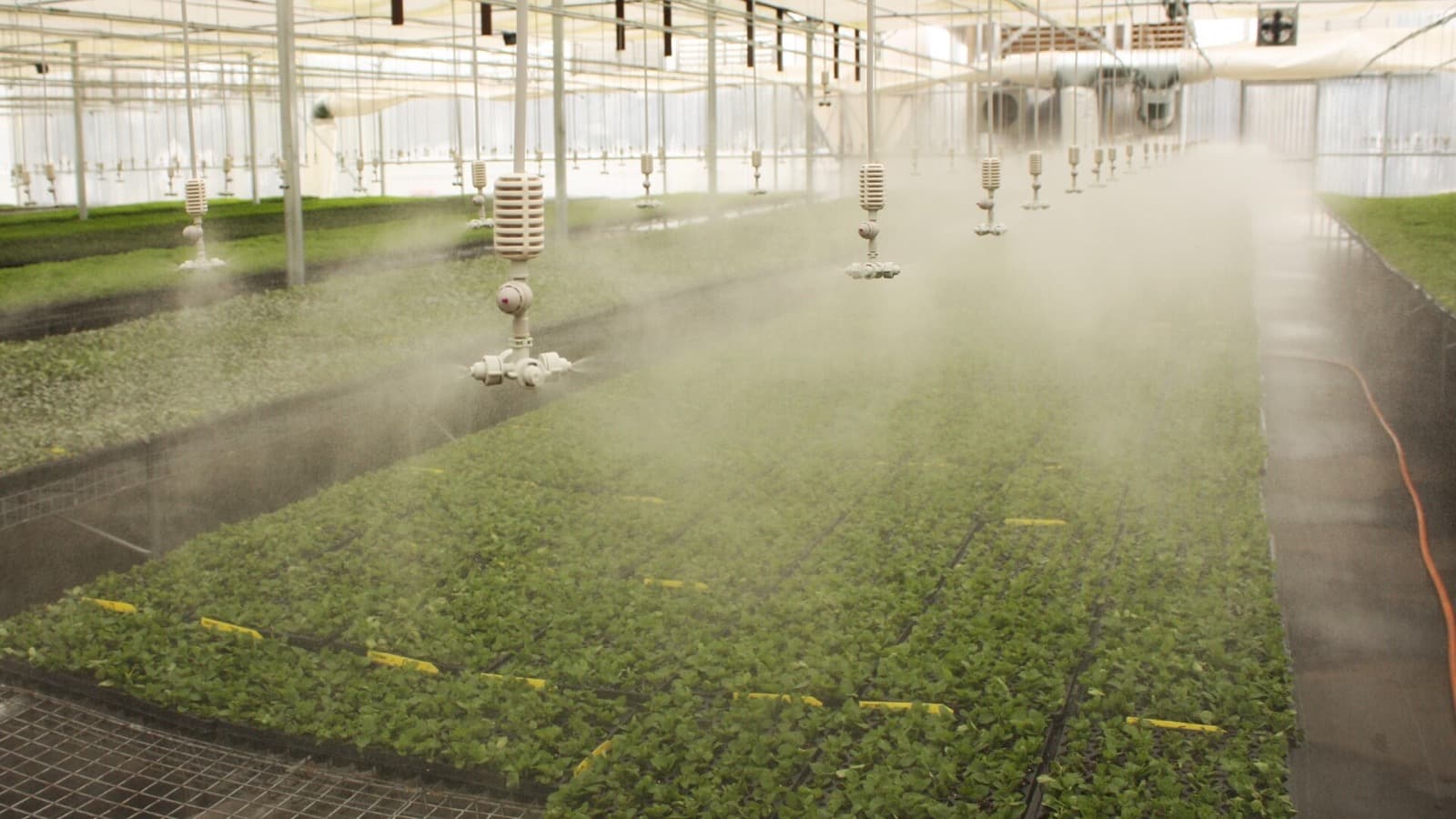
A commercial greenhouse can become dependent on electricity even when most of its heating energy comes from natural gas, propane, biomass, or another fuel. Controls, boiler pumps, circulation fans, exhaust fans, vent motors, irrigation pumps, alarms, communications, and inflated double-poly coverings may all stop when grid power is lost.
Ontario farm guidance identifies heating, ventilation, irrigation, computerized controls, and alarms as systems that need an emergency power plan. University of Florida greenhouse guidance similarly identifies water pumps and ventilation fans as common major backup loads.
A battery system can support some or all of these functions, but it needs to be sized from the greenhouse's actual operating schedule. The calculation has two separate parts:
- Peak power in kW, including loads that may start together
- Energy capacity in kWh, based on how long each load runs
Both are required. A battery can hold enough energy for an outage and still be unable to start the largest motor. It can also have enough inverter output to run every device but too little stored energy to last through the required period.
Start with the critical-load list
Do not begin by adding every breaker rating in the greenhouse. Begin with the equipment that protects crops, climate, water delivery, and communications during an outage.
Typical critical or high-priority loads include:
- Environmental controllers and sensors
- Alarm, internet, and communications equipment
- Horizontal airflow and circulation fans
- Exhaust fans and intake shutters
- Boiler controls, circulation pumps, and distribution blowers
- Irrigation, fertigation, and well pumps
- Vent, shade-curtain, and thermal-screen motors
- Air-inflation blowers for double-poly greenhouse covers
- Sump and drainage pumps
- Emergency and work lighting
Supplemental grow lighting, electric resistance heat, chillers, large heat pumps, packing equipment, and cold storage can be much larger loads. They should be listed separately so the operator can decide whether they need full operation, reduced operation, or an orderly shutdown during an outage.
Record nameplate data instead of estimating from appearance
For every load, record the electrical information shown on the equipment nameplate or manufacturer documentation:
| Item | Information to record |
|---|---|
| Motor or appliance | Rated watts, amps, or horsepower |
| Supply | Voltage and phase |
| Operation | Continuous, cycling, seasonal, or intermittent |
| Runtime | Expected hours during the backup period |
| Starting demand | Locked-rotor amps, surge rating, or manufacturer data |
| Priority | Critical, high priority, deferrable, or nonessential |
| Control method | Manual, thermostat, controller, timer, or variable-speed drive |
If a single-phase nameplate provides volts and amps but not watts, multiplying volts by amps gives apparent power in volt-amperes. Motor input and real power also depend on power factor and efficiency, so a licensed electrical contractor should confirm the final design.
For three-phase equipment, use the equipment documentation or a qualified electrical calculation. Do not size a system from horsepower alone when the actual voltage, efficiency, power factor, and starting method are available.
Calculate energy from duty cycle
Many greenhouse loads do not run continuously. A thermostat may cycle a boiler pump. An irrigation pump may operate in short scheduled blocks. Exhaust fans may stage according to temperature.
Daily energy is calculated as:
Power in kW x operating hours = energy in kWh
When equipment cycles, use its expected duty cycle:
Rated kW x hours available x duty cycle = energy in kWh
For example, a 3 kW fan bank available for six hours at a 50% duty cycle uses approximately:
3 kW x 6 hours x 0.50 = 9 kWh
Duty cycle should be based on seasonal operating records where possible. A summer design day and a winter night can produce very different backup requirements.
Worked example: one day of critical greenhouse loads
The following example is a planning exercise for a greenhouse with fuel-fired heat. It does not represent a universal greenhouse load profile. The equipment nameplates, controls, crop, glazing, weather, and operating schedule determine the actual values.
| Critical load | Average running power | Backup operation | Energy use |
|---|---|---|---|
| Environmental controls and sensors | 0.10 kW | 24 hours | 2.4 kWh |
| Four circulation fans | 1.00 kW total | 24 hours | 24.0 kWh |
| Staged exhaust fan bank | 3.00 kW | 6 hours total | 18.0 kWh |
| Irrigation and fertigation pump | 1.50 kW | 2 hours total | 3.0 kWh |
| Boiler pumps, controls, and blowers | 2.00 kW | 8 hours total | 16.0 kWh |
| Vent and shade motors | 0.50 kW | 1 hour total | 0.5 kWh |
| Alarm, network, and communications | 0.10 kW | 24 hours | 2.4 kWh |
| Calculated total | 66.3 kWh |
Adding 20% reserve for conversion losses, load variation, and operational flexibility brings the planning figure to approximately:
66.3 kWh x 1.20 = 79.6 kWh
The reserve is a planning allowance, not a fixed rule. A facility may choose more reserve when crop risk is high, outages are frequent, recharge access is limited, or weather can increase fan and pumping runtime.
Check the coincident peak load
The energy calculation above does not establish the required inverter output. The next step is to identify which loads can run at the same time.
If every load in the example operated together, the running total would be:
0.10 + 1.00 + 3.00 + 1.50 + 2.00 + 0.50 + 0.10 = 8.20 kW
The system also needs to account for motor starting demand. Fans and pumps can briefly draw several times their normal running current, depending on motor type and starting method.
The peak-power review should document:
- The largest individual motor start
- Motors likely to start at the same time after grid loss
- Direct-on-line, soft-start, and variable-frequency-drive equipment
- Automatic control sequences after transfer
- Single-phase and three-phase requirements
- Voltage requirements for each backed-up circuit
Staging motors can reduce the required peak. For example, controls can bring circulation fans online first, then start exhaust fans, followed by pumps. Ontario guidance for farm generators similarly recommends reconnecting motors one at a time before adding other loads.
Separate thermal energy from electrical support
Greenhouse heating requires a careful distinction between thermal output and electrical support.
A gas-fired boiler may provide hundreds of kilowatts of heat while its electrical requirement is limited to controls, pumps, valves, and blowers. In that case, a battery backs up the electrical support equipment, not the full thermal rating of the boiler.
An all-electric greenhouse is different. Resistance heaters, electric boilers, and heat pumps can dominate both peak kW and stored energy. A 30 kW electric heater running for four hours uses 120 kWh before other greenhouse loads are added.
Supplemental lighting should also be treated separately. Lighting power multiplied by the scheduled hours can create a large energy requirement. During an outage, operators may choose to suspend or reduce lighting while retaining climate control, irrigation, and alarms.
Size for more than one outage duration
A single runtime target can hide operational risk. Build at least three cases:
| Scenario | Planning purpose |
|---|---|
| 15 to 30 minutes | Covers short interruptions and transfer events |
| 4 to 8 hours | Covers a typical work period or utility restoration window |
| 24 hours or longer | Covers severe weather, remote sites, or delayed service restoration |
For longer events, the plan needs a recharge source. Grid power may return before the battery is empty, but it should not be the only assumption.
Possible recharge arrangements include:
- Grid charging after service is restored
- Solar-assisted charging
- Scheduled generator charging
- A hybrid system using battery power between generator runs
Solar can contribute useful energy, but greenhouse backup should not assume full rated PV output during cloud, snow, smoke, or short winter days. See our guide to solar charging in cloudy weather for the main production variables.
Battery-only and hybrid configurations
A battery-only configuration can work when the critical load is defined, outage duration is limited, and a reliable recharge window is available. It provides quiet operation with no direct exhaust while discharging.
A hybrid configuration is often more practical for long outages. The battery carries controls, fans, alarms, and overnight loads. A generator runs during scheduled recharge periods or when heavy equipment is required.
This arrangement can reduce continuous engine runtime while retaining an energy source for a multi-day event. It also allows the generator to operate under a more deliberate load instead of idling for long periods to serve small controls and communications equipment.
Transfer, controls, and electrical installation
Backup equipment must be integrated with the greenhouse electrical system correctly. Ontario farm guidance recommends a transfer device and installation by a licensed electrical contractor.
The design review should cover:
- Automatic or manual transfer requirements
- Isolation from the utility during an outage
- Whether greenhouse controllers restart correctly after transfer
- Acceptable voltage, frequency, and waveform for sensitive controls
- Grounding, overcurrent protection, and disconnects
- Load-shedding sequence when battery state of charge reaches a limit
- Alarm notification if backup power fails or reserve falls below a threshold
- Routine testing under representative load
A short transfer time does not guarantee that every controller, drive, or communications device will ride through the event. Compatibility should be confirmed with the equipment manufacturers and tested before crop protection depends on it.
Where Skyridge Power systems fit
The Apex Station is the closer fit for the worked example because it provides:
- 120 kWh of LiFePO4 storage
- 30 kW continuous output
- Single-phase and three-phase configurations
- Grid, generator, and solar charging compatibility
- Up to 30 kW of solar input
- Less than 20 ms transfer time in the published specification
The example's calculated 79.6 kWh planning requirement is below the Apex Station's nominal storage capacity. Final usable runtime still depends on reserve settings, conversion losses, temperature, motor starts, actual duty cycles, and system configuration.
The Apex Mobile provides 16 kWh nominal capacity, 14.4 kWh usable capacity, and 12 kW continuous output. It may fit a smaller greenhouse zone or a narrow critical-load package such as controls, alarms, communications, circulation, and scheduled irrigation. Its energy capacity would not cover the full 66.3 kWh daily example without recharge or substantial load reduction.
Skyridge Power can use equipment nameplates, interval data, control schedules, and outage targets to prepare a site-specific battery or hybrid configuration. The planning process is similar to the method in our jobsite tool and equipment power guide, with additional attention to continuous biological and climate-control loads.
Final takeaway
Commercial greenhouse backup sizing begins with crop-protection priorities. Controls, ventilation, circulation, heating support, irrigation, alarms, and cover-inflation equipment usually come before supplemental lighting and general production loads.
Calculate daily kWh from actual runtime and duty cycle. Calculate peak kW from the loads that can overlap, including motor starting demand. Then add reserve and define how the system will recharge during a longer outage.
Primary references include Ontario guidance on starting a farm and greenhouse emergency power, Ontario's technical guide to on-farm generators for emergency use, University of Florida guidance on auxiliary power for greenhouse operations, and UConn Extension guidance on greenhouse weather preparation and backup power.
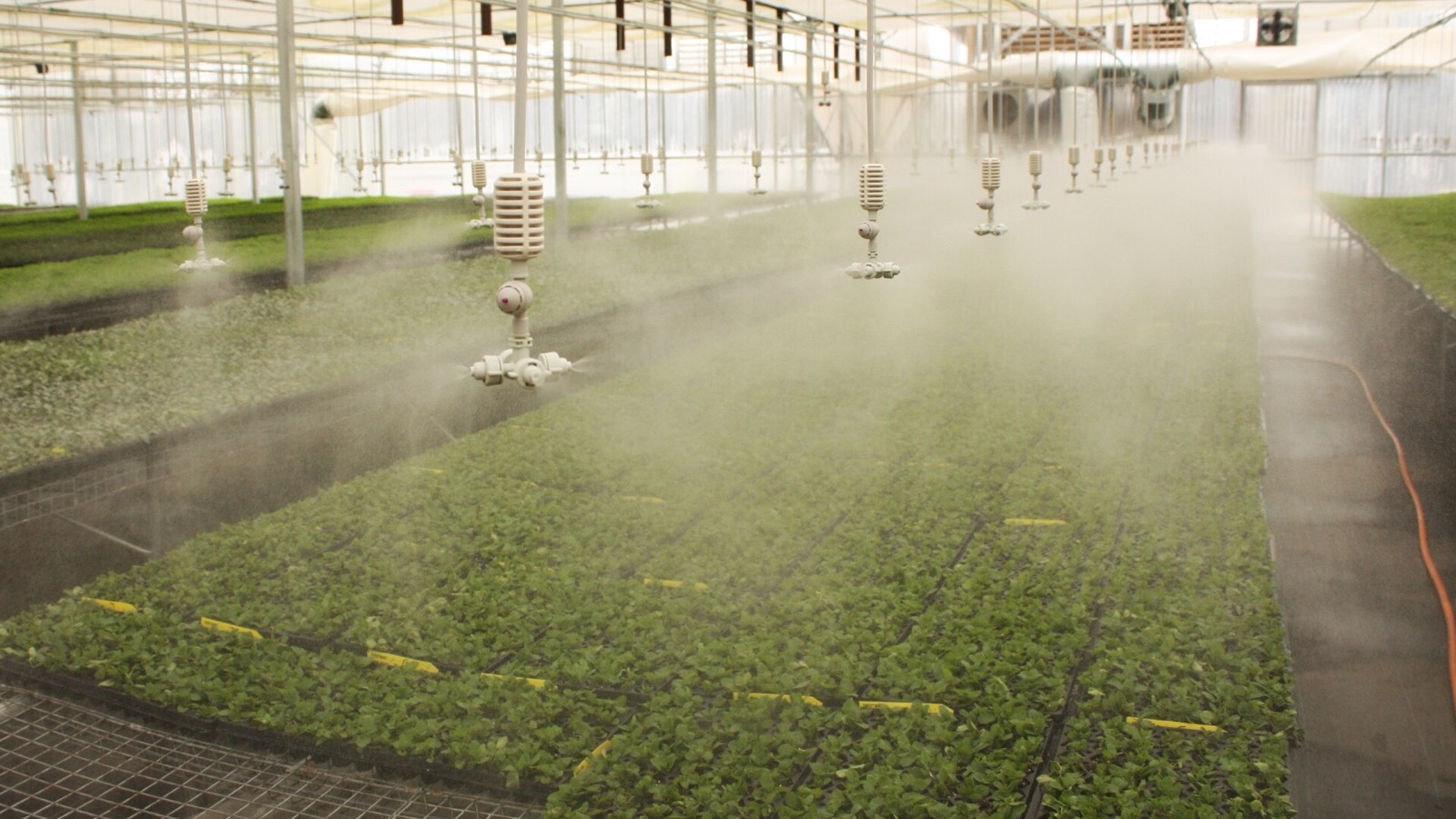
Image source: Irrigation in a Greenhouse by Alabama Extension, dedicated to the public domain under CC0 1.0. The image was cropped to a landscape format.
